Our value proposition
We lower the lifetime cost of your project by 30% or more. The key is to redefine what it means for software to be "done": meeting functional requirements is not enough. Our tools make architectural rules and quality standards enforceable in a simple and effective way.
We make technical debt visible
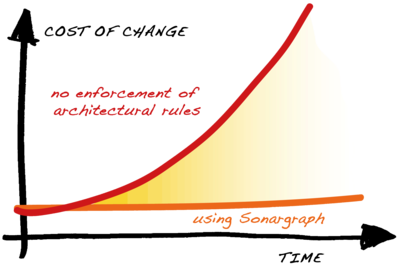
Industry research has shown how technical debt harms the quality and maintainability of software systems. And it grows every day as developers introduce architectural flaws and code quality issues, either unintentionally or by neglecting proper coding and design rules.
Just like monetary debt, technical debt requires interest payments later on, in the form of effects most software professionals will recognize:
- Code changes become more difficult
- New developers need a very long time to become productive
- A change in one place breaks an unrelated part of the codebase
- Team agility and responsiveness decrease
- Deadlines and budgets are blown
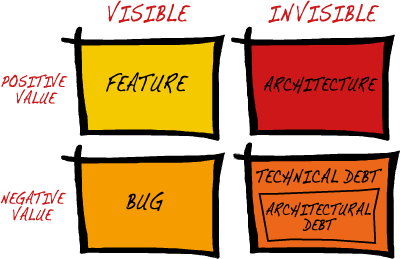
Architectural debt: the loss of architectural cohesion
Architectural debt is a particularly toxic form of technical debt. Many technical debt issues can be fixed with a local change, but architectural issues are much harder to fix once they have grown beyond a certain limit. Fixing them requires risky large-scale refactoring, a lot of time, and appropriate tool support.
Use our tools to tackle technical debt
- Visualize the dependency structure and architecture of a codebase
- Assess the architectural integrity of a system in under 30 minutes
- Simulate refactorings without ever changing the code
- Find effective refactorings to break up cyclic dependencies
- Identify other technical debt: code duplication, design smells, bad metric values
We help you break the cycle of growing technical debt
"Knowing is half the battle." The first step is an honest assessment of the existing technical and architectural debt. The next is a plan to eliminate the most critical issues while avoiding new ones. Our products integrate into your existing development environment and support you throughout this process.
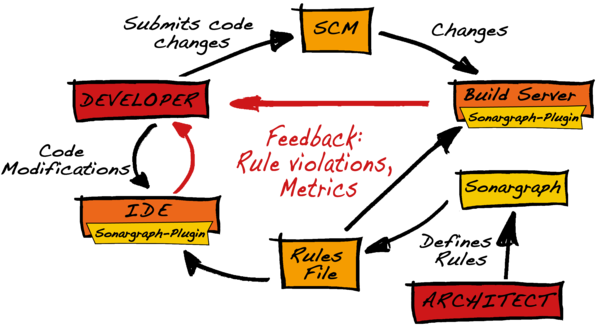
You define an architectural blueprint for your system, so our tools can warn developers immediately when they create a dependency that violates it. You also define a quality model with rules based on metrics and other criteria. Developers get immediate feedback on violations and can fix issues while it is still easy to do.
We provide transparency about the technical quality of code
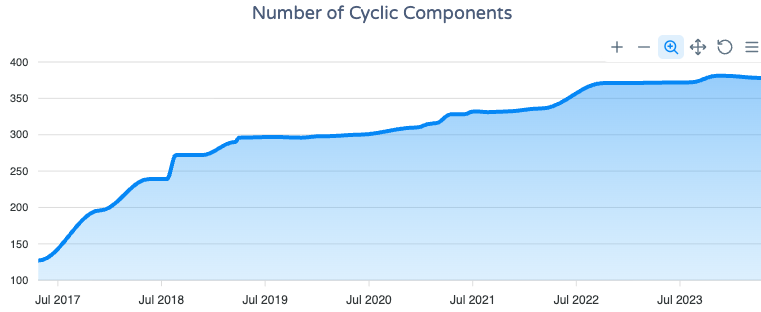
Track key metrics over time and make your project's technical quality transparent. Trend charts tell you whether things are changing for the better or for the worse, so you can take action before they get out of control. You are not flying blind anymore.
What that means for your team
More agility and productivity
With our tools in your development process, your team spends less time fixing problems rooted in technical and architectural debt and more time on the business value of your system. More productivity means more agility, which is crucial for keeping an edge in a rapidly changing technological environment. And with our Zügel MCP server your AI coding agents respect the same architecture rules, so AI-generated code adds to that agility instead of eroding it.
Exceptional and sustainable software
Several customers reduced their defect rates by a factor of ten compared to similar projects without automated architecture and quality rule enforcement. A formally defined architecture and quality model make it easier to transfer knowledge between teams, and a codebase without architectural flaws extends the lifetime of a system so it can earn back what was invested in it.
Empowering software craftsmanship
Code should not just provide the desired functionality but conform to a set of architectural and quality rules, and no system should go into production unless it meets your standards for quality. Solid craftsmanship requires the right tools: Sonargraph-Architect is ideal for code comprehension, quality assessments and reverse engineering of complex codebases, and lets your software grow without the usual build-up of architectural and technical debt.
Let our tools help youHow Sonargraph would help your business
An entertaining short video introduction that explains how your company would benefit from using Sonargraph.
Get started
Try our tools on one of your projects. Evaluations are free and without obligation. Register or log in to download our products and request evaluation licenses.