- Our Value Proposition
- Sonargraph
- Sonargraph Pricing
- ArcTree
- Documents & Whitepapers
- Downloads
- Tutorial Videos
- Services
- Book an Online Meeting
- Subscribe to Newsletter
- Support Desk

Sonargraph and AI
ArcTree Released
Sonargraph Supports C# 14
Company News
Sonargraph and AI
MCP server coming soon
It turns out that our architecture DSL is the perfect AI companion. Claude is as excited as I am and said: "I think this is one of the most important ideas in AI-assisted development. A capable coding agent without guardrails can make a mess at speed. An architecture-aware agent that checks constraints before acting is something you can actually trust in a real codebase." We already have a working prototype for Java and will release a version supporting a subset of the DSL for physical architecture models in the near future.
ArcTree Released
Dependency Visualizer for IntelliJ IDEA
ArcTree is a plugin for IntelliJ IDEA with a focus in dependency visualization. It brings Sonargraph's exploration view directly into your IDE. Read more here. We also prepared a tutorial video on YouTube.
Sonargraph Supports C# 14
The new 26.1.2 release now requires .Net 10, but supports C# 14 and .slnx solution files.
Sonargraph 26.1 released
Now with support for Go
The newest release contains full support for the Go programming language. Also we changed our versioning. The first number is now the calendar year. Here is a tutorial video that explains the project setup.
Breaking the Big Ball of Mud
Read our newest blog article
It can be found here.
Sonargraph Now Supports Java 25
Release 15.4.2 adds full support for Java 25.
July Newsletter
Read it here.
Spring Modulith & Sonargraph - Better Together
With our newest 15.4 release we added the capability to generate Sonargraph DSL for Spring Modulith projects. Read all about it in our newest blog article.
Changes to the Sonargraph Dashboard
Improved metrics for early detection of big balls of mud.
We improved dome metrics in the Sonargraph dashboard. Those changes are rolled out with Sonargraph 15.2.0. Read all about it here.
Sonargraph 15 Released
The new release brings new variants of Sonargraph for the Aarch64/ARM 64 architecture for Linux and MacOS. Otherwise changes are mostly internal. We updated all libraries, streamlined the project structure and build process and now run on Java 21. That should bring some performance improvements.
Auto-Update from 14.x to 15.x is not possible. You need to re-install Sonargraph if you would like to update. Auto Update will then again work after that. We now also have a "Check for Updates" feature in the Help menu.
Please note, that Sonargraph build now also needs to run on Java 21.
Structure101 Customers Welcome
Special Offer
If you are a current user of Structure101, you probably noticed that the tool has been acquired by SonarSource and is not available in its current form anymore. If you are looking for an alternative, please have a look at Sonargraph. It covers most features of Structure101 and has a lot of extra capabilities not available in Structure101.
We are willing to credit part of your investment into Structure101 towards purchases of Sonargraph licenses. Please contact us, if you are interested.
We also provide some free online training to help with the transition.
Code Cancer is Costing Billions
Learn more about code-cancer in our newest blog article.
Sonargraph 14 Released
TypeScript support available now
Finally we were able to release our support for the TypeScript language. All you need is an active installation of Node.js on your machine. Typescript projects are created based on the tsconfig.json file.
February 24 Newsletter
New interactive cycle view
Read it here.
Sonargraph-Explorer Reborn
Admittedly we had a rough week for Sonargraph-Explorer and its users. After we lost several paying customers because they downgraded to the free Explorer license we first decided to pull the plug and kill the product. After all the original idea was that the product would ease introducing the commercial variant Sonargraph-Architect and help us to win more paying customers.
After a lot of talks with users and our own development team we decided to soften that decision by removing two features from the original Explorer variant, but otherwise continue the free product. In particular we removed the cycle view and the exploration view.
While that reduces the usefulness of Sonargraph-Explorer it still remains a good entry level tool to collect quality metrics and detect cyclic dependency groups. We think it balances our need to pay our bills with the interest of users who would like to explore the technical quality of their systems without being forced to pay for a license.
One hint if you currently have an explorer license. You need to upgrade to the newest version. The Explorer license only works with Sonargraph versions released after Oct 4th 2023.
June 23 Newsletter
C# analyzer now using Roslyn
Read it here.
Sonargraph 13 Released
Much improved C# support
Our newest major release comes with a major rewrite of our C# support. Our analyzer is now based on the Roslyn open source C# parser. This will greatly simplify the project setup and will also make it easier for us to keep up with language changes. See our documentation for more information.
There also numerous other improvements and bug fixes for this release. For example you have now access to issues over the script API. See the lates release notes for details.
Podcast Rechenzeit
Architekturbewertung mit Metriken
This is a new Rechenzeit podcast episode (in German) focusing on assessing architecture via metrics featuring one of our founders Alexander von Zitzewitz. https://www.wps.de/aktuelles/softwarearchitektur-bewertung-mithilfe-von-metriken/event:2023-04-30T10-12
February Newsletter
DSL improvements and more
Read it here.
August Newsletter
Kotlin support and new license options
Read it here.
Sonargraph Github Action
For Maven based Java project
We just released our first Github action. It works for all Maven based Java projects and will upload the metrics of your project to an instance of Sonargraph-Enterprise. By default we use the public instance which is free to use, but you can also use this action with your own instance. Sonargraph-Enterprise allows you to track metric changes over time and also supports the creation of badges in your README.md file to display important system metrics.
Design for Change
New Java Magazin article
This article (written in German) focusses on how to keep you software flexible enough to enable change.
Sonargraph 12 Released
The new release comes with an improved dashboard, a better exploration view and much faster C/C++ parsing speed. Details can be found here.
New Webinar Series
now available as Youtube playlist
The recordings from our webinar series from October 2021 are now available as a Youtube playlist.
Licensing Refactored
Check out our new licensing options
After switching to Digital River as our new payment processor we completely reworked the pricing and licensing for Sonargraph and now offer three new subscription based options: team licenses, integrator licenses and personal licenses. You have a choice between monthly and yearly subscriptions. If you go for yearly you will get two months for free. All the details are here.
Sonargraph featured in Architecture TV
Sonargraph was featured in Architecture TV, a Youtube show moderated by Java Champion Eberhard Wolff. (Content is in German language)
May 2021 Newsletter
3D Treemaps and Kotlin Support
Read it here.
Preventing Software Rot
Everybody who has any responsibility in developing or running mission critical software should read this article. One key point in avoiding disasters like described in the article is have a documented and enforceable architecture and quality model, a key benefit of Sonargraph. That will allow changes of ownership with a lot less trouble. It also helps avoiding disasters in the first place.
Dec 2020 Newsletter
Sonargraph can now detect hotspots in your code
Read the newsletter here.
August 2020 Newsletter
Team Licenses and Quality Gates
Read it here.
June 2020 Newsletter
Sonargraph-Enterprise comes online
Please follow this link to read the newsletter.
April 2020 Newsletter
The sword of architecture Ninjas
Please follow this link for the newsletter.
O'Reilly Interviews our CEO
Why architecture matters
Watch the full interview on Youtube. It was recorded during the O'Reilly Software Architecture conference in San Jose, CA in June 2019.
Sonargraph wins "Jury's Choice Award" for best quality tool
During the Software Quality Days 2019 in Vienna Sonargraph has been awarded the "Jury's Choice Award" for best software quality tools. Check out this picture to see the proud winner holding their award.
Sotograph 5.0 Released
Now supports TypeScript and C++ 17
We just released Sotograph/Sotoarc 5.0. The focus was on improving support for C++ by adding capabilities for all the newer language versions up to C++ 17. With TypeScript we also added a new language to Sotograph and Sotoarc, which will open up the tool for front end programmers. Now the Soto tool family supports Java, C#, C and C++, PHP, ABAP and Typescript.
Oct 2018 Newsletter
Sonargraph 9.9 released
Please follow this link for the newsletter.
Sonargraph 9.7 Released
This new release comes with a couple of powerful new features and bug fixes, among them:
- A new session view based on ideas from our legacy tools SotoArc.
- Annotations and inheritance structure can now be used for architectural assignment.
- The architecture DSL now supports logical models.
- Cycle groups can be marked critical if they grow over a certain size.
- Metric threshold violations can be marked as errors.
For more details please check the release notes.
February 2018 Newsletter
Sonargraph evolves
Please follow this link to read our newsletter.
Sonargraph supports Java 9
With our new release 9.4.6.462 Sonargraph now officially supports Java 9.
April Newsletter
12 years of hello2morrow and more
Check out the newest edition of our newsletter here.
Sonargraph 9.3 Released
Architecture DSL evolves, better C++ support and more
The new release adds new capabilities to our architecture DSL as described in this blog article. Moreover we added numerous improvements to simplify project setup and parsing in the C/C++ language provider. We also added a new workspace filter that will allow you to specify parts of your code base that will not generate Sonargraph issues. That is particularly useful for generated code and for legacy code that you do not plan to change anymore. Please check the release notes for all the details.
Sonargraph 9.1 Released
with IDE plugins for Eclipse and IntelliJ
The new release adds the new Sonargraph-Developer license which enables the use of the plugins and the use of a read-only version of Sonargraph-Architect. We also improved our Maven importer to better work with binary repositories and support Tycho projects. Other than that the new release contains numerous little improvements and some bug fixed. Check the release notes for details.
September Newsletter
Sonargraph nominated for Jax-Innovation-Award
Read the details here.
Sonargraph 9.0 Released
Now supports virtual refactorings
Today we released Sonargraph 9.0. We added a bunch of powerful new features, improved the performance and lowered memory consumption.
Here is a list of the most important new features:
- Enhanced architecture DSL as described in our newest blog article.
- Virtual move and rename refactorings for components, packages and component containers.
- Added new metric "Component Rank", based on the Google Page-Rank algorithm.
- The Graph View now supports architecture artifacts.
- Our HTML reports now scale much better for large projects. We also added some Javascript to make tables filterable and sortable.
- Type level representation viewers.
- Full support for floating licenses. Contact us if you'd like to upgrade your existing licenses.
- Representation viewers now have an extra view option to only show violations.
Mac users will have to do a clean install since auto-update will not work for upgrades from 8.x to 9.0. All other users can simply use out automated update feature.
April Newsletter
Sonargraph Gradle Plugin
Check out our April newsletter. In the last couple weeks we focussing heavily on Sonargraph-Build and the associated integrations. Sonargraph 8 can now integrate with Gradle, Maven, ANT, Jenkins and SonarQube. More details here.
December Newsletter
Coupon inside
In our December newsletter we discuss the new Sonargraph-Platform and update the roadmap for our development. It also contains a 300 USD / 300 EUR coupon valid until the end of 2015. So if you are on the fence anyway, this is a good opportunity to buy a license.
Sonargraph 8.6.2 Released
Now Sonargraph-Explorer is free
The 8.6.2 release is the first release of our new Sonargraph-Platform. The platform has two product variants: Sonargraph-Explorer for the visualization of dependencies and the computation of basic project metrics. Sonargraph-Architect adds automated architecture checks based on a powerful DSL, a Groovy based scripting engine, a checker for duplicate code, virtual refactorings, issue resolution workflow, advanced metrics like LCOM4 and a break up computer for cyclic dependencies.
We decided to make Sonargraph-Explorer a free product for Java and C#. It is ideal to assess the structure and technical quality of a software system and to visualize complex dependency structures.
Sonargraph-Architect will stay a commercial product and now also supports C# and C/C++ next to Java. You can evaluate the product for free and also buy it directly from our web-site.
September Newsletter
Architecture DSL and Roadmap Update
In our September newsletter we discuss the newest features in the 8.6 release of Sonargraph-Explorer and give you an update on our current roadmap.
Sonargraph-Explorer 8.6.0
Featuring brand new architecture DSL
This new release is a major step forward to the consolidation of all our products into one new platform. Now you are able to check architectural models described with a DSL (domain specific language) with Sonargraph-Explorer and Sonargraph-Explorer Build. The new DSL is described in a series of blog articles on our blog site. We also added an architecture modeling tutorial to the documentation. The new language is very powerful and allows fine grained control over the dependencies allowed between different architectural artifacts. It is also independent from your programming language, so it can be used with all the languages supported by the Sonargraph platform. This allows you to express the architecture of your system as code that is easy to read and understand by developers and architects.
The next step from here is to allow architectural modeling not only by using the text editor, but also by using the exploration view so that you can work with a hybrid approach. That feature is planned for Sonargraph-Architect version 9 which we will release before the end of 2015.
The new release also contains many other new features, improvements and bug fixes. For example we now support the deletion of dependencies as virtual refactorings. Please check the release notes for more details.
Sonargraph-Explorer 8.5.1
Featuring the new Dashboard
We released version 8.5.1 of Sonargraph-Explorer. We finally managed to finish the migration to Eclipse RCP 4, which was quite a nightmare. The most visible new feature is the new dashboard view. In this release the dashboard is still pretty static, but soon it will be fully configurable, meaning that you can pick and choose the data you want to see in the dashboard. Additionally all dependency graphs now allow to filter by dependency type. As usual the release also contains many improvements and bug fixes. Check the release notes for all the details.
March Newsletter
New Features and Roadmap Update
The newsletter explains the newest features of Sonargraph-Explorer and our roadmap to unify all our products under the new language agnostic platform. It also contains a discount coupon of 100 EUR/USD (depending on your region) that can buy you a completely free 90 day license of Sonargraph Explorer for Java or C#. (90 day licenses cost 50% of a yearly license) Hurry up, the coupon will expire on March 31st 2015.
Check out our new Blog
Tips, Tricks and Ideas for Software Craftsmen
We opened a blog site and plan to add new content about twice a month. You will already find two articles there. One about the different categories of technical debt and why they should not be treated equally, the second one shows how you can use the scripting feature of Sonargraph-Explorer to identify the components that contribute the most to overall system coupling. Please share your opinion and feedback by adding comments to the article. You can reach the blog site by clicking on the "Blog" menu entry.
Sonargraph-Explorer Released
Supports C#, C/C++ and Java
Today we officially released Sonargraph-Explorer. The new product supports Java, C# and C/C++ out of the box and can be categorized a the swiss army knife for software architects, software quality analysts and developers.
For C/C++ the program comes with instant support for Visual C++, Gnu C/C++ and CLang. Other compilers can be supported by adding specific compiler configurations. Our parser supports all the newest additions to the C++ language.
For C# Sonargraph supports Microsoft and Mono implementations. The newest version of Java is supported as well.
Sonargraph 7.2 Released
Now includes full support for Java 8
Our newest release of Sonargraph now fully supports Java 8. We also improved the performance of the parser and the Eclipse plugin, especially when the Maven Eclipse plugin was also present.
For our SonarQube plugin no update is needed. Just update the version of Sonargraph referenced during the build process. The Jenkins plugin just runs through the update process on the Jenkins site and should be available within the next couple of days.
Our upcoming product Sonargraph-Explorer is in the final stages of its official release. Here we already support the newest versions of all three supported languages Java, C# and C/C++. You can already evaluate the product using an evaluation license.
Sonargraph-Explorer Beta Released
Open beta phase until end of September
Today we released a beta version of Sonargraph-Explorer. The new product will support Java, C# and C/C++ out of the box and can be categorized a the swiss army knife for software architects, software quality analysts and developers. During the open beta phase everybody can use the product for free. Please use this opportunity to have a look at the product and let us know, what you think about it.
BMW Case Study
Sonargraph helped to reduce the defect rate of a mission critical system by a factor of ten
The new case study explains how Sonargraph-Architect helped BMW to reduce the defect rate of a mission critical software system by a factor of 10 while improving team agility and end user satisfaction.
Sotograph 4.3 released
There are various improvements over all the Soto tool components. Some of them are:
- the Sotoarc engine has been enhanced with an option to reduce the memory for checking and visualization. This makes it possible to analyse and visualize very large software systems.
- a new Soto-API is introduced to script Sotograph via Sotograph queries. This opens a wide range to compact customer analysis steps into a single query.
- there is also a new, comfortable wizard integrated to create and export a full functioning daily batch job based on a previously filled version.
- the ABAP parser stores information about external library artifacts into the Soto repository. This allows the analysis of dependencies into an external ABAP library.
- the external code checker plugins PMD and Checkstyle for Java are updated to latest version.
Sotoarc/Sotograph customers will receive the new release as a part of their valid maintenance service.
New Case Study
Environment Agency Austria Achieves Sustainable Software Development
The case study describes in detail how the Umweltbundesamt (Environment Agency Austria) adopted a development process centered around code quality and how Sonargraph helped to make this initiative a great success. You will find the new case study in our whitepaper section.
Sonargraph Jenkins Plugin Released
Simplifies Automated Enforcement of Architecture and Quality Rules
Our brand new Jenkins plugin makes it even easier to integrate Sonargraph into your continuous integration environment. The plugin allows to mark a build as "unstable" or "failed" depending on a wide range of configurable triggers. E.g. it is possible to make the build fail if architecture violations or package cycles are detected.
Moreover important project metrics like "Structural Debt Index" and "Average Component Dependency" are tracked and their short term and long term trends are displayed in a set of charts. This makes it easy to spot a negative quality trend before it becomes to difficult to implement effective countermeasures.
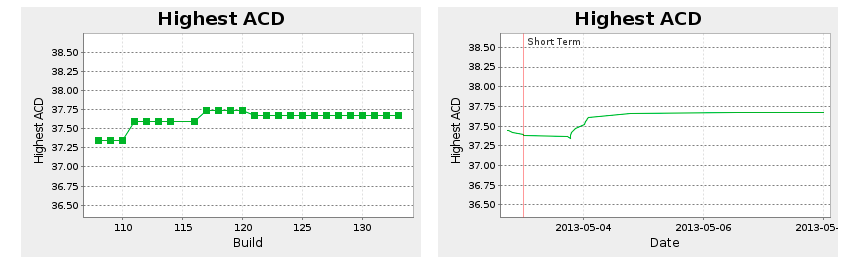
The plugin is available immediately in the Jenkins plugin manager.
hello2morrow comes to Latin-America
New Subsidiary in Colombia
hello2morrow created a new subsidiary in Medellin, Colombia. The new office will be used as an additional development center reinforcing the global development team of the company. Medellin has an excellent university with a strong computer science faculty. That makes it easier to find highly qualified and motivated developers for our product family.
Dietmar Menges, the CTO of the company, is leading the new subsidiary. By increasing the development capacity of the company it will be possible to accelerate the development of the next generation of Sonargraph. Sonargraph 8 will support additional languages like C/C++, C# and incorporate a lot of innovative new features that are not available in other static analysis products. The new release is scheduled for the second half of 2013.
hello2morrow launches its next generation product Sonargraph for Java
Sonargraph melts SonarJ and Sotograph for Java into one product
When hello2morrow and Software-Tomography merged in 2008, the goal was to merge the capabilities of SonarJ (a hello2morrow product) and Sotograph (a Software-Tomography product) into a powerful next generation static analysis platform. With today’s release of Sonargraph for Java an important milestone of this project has been reached. All users of SonarJ and Sotograph with a active support and maintenance contract will be eligible for a free upgrade.
SonarJ is now renamed to Sonargraph for Java and also replaces Sotoarc and Sotograph for Java. The new product combines the best features of both worlds and comes in two major product variants.
Sonargraph-Architect has its focus on software architecture and structure. Software architects can create two-dimensional architectural models for their application that act as a structural blueprint. Sonargraph-Architect will detect any violations of the blueprint and inform developers about those violations while they are working in their favored IDE. The product comes with plug-ins for Eclipse and IntelliJ-IDEA. Using Sonargraph-Architect bridges the gap between software architects and developers and helps to eliminate one of the most critical issues for many software development teams, which is the uncontrolled accumulation of structural and technical debt in the development process. Many studies prove that most non-trivial projects suffer from severe structural erosion (loss of architectural cohesion and structure), which acts like an ever growing tax on code changes. Avoiding structural erosion leads to significant gains in team productivity and technical quality. The tool also allows simulating refactorings on the code without actually touching the code. If the architect approves a set of refactorings, it can be passed to the IDE, which performs the necessary code changes according to the detailed description provided by Sonargraph-Architect. The tool also comes with an integrated dashboard that integrates the most important architectural and structural project metrics on one page.
Sonargraph-Quality is the big brother of Sonargraph-Architect. It includes all the features of Sonargraph-Architect, but also covers many additional aspects of technical quality. Currently we do not know of any other tool that delivers such a comprehensive and detailed set of quality data for Java projects. The heart of Sonargraph-Quality is its repository. The repository stores snapshots of Java applications containing software metrics, a complete dependency model, architectural models, violations, refactorings and open tasks. Using the repository Sonargraph-Quality can create trend charts of project metrics, compile lists of problems added since the last build or find out which problems have been solved within a given time frame. Sonargraph finds duplicated code blocks and can integrate 3rd party code checkers. Out of the box it comes with support for CheckStyle and PMD. FindBugs support will be added shortly.
In addition to calculating hundreds of different software metrics Sonargraph also includes many predefined queries that can be used to locate bad smells, design patterns or anti-patterns.
Here is an example of the issues that can be found using predefined queries:
- Superclass knows subclass
- Non-local attribute access
- Overriding attributes
- Unused methods, attributes and classes
- Comments: 'Hack' etc.
- Classes, methods and attributes that do not need to be public
- Missed abstraction: methods and attributes
- Package call interface
- Dependency bottlenecks
- Structural debt index
- And many more...
The format of a snapshot is fully document so that users can easily create their own project specific metrics and queries using standard SQL. This way the user can extract pretty much any information that is contained in the snapshot model.
Typically Sonargraph-Quality is integrated into the build system so that snapshots are created automatically during the nightly build. It integrates with ANT, Maven, Sonar and Jira, just to name a few popular developer tools.
By customizing one of the predefined quality models users can define their own target ranges and tolerance level for an arbitrary set of project metrics. Customized quality models can be exported and imported to facilitate the creation of company wide quality standards and benchmarks.
The reporting engine of Sonargraph allows the automatic creation of a variety of useful reports ranging from one-pagers containing only a couple of key project metrics up to multi-page detailed metric and trends reports. Reports can contain charts and diagrams and can be fully customized by the user.
Setting up Sonargraph on an existing Java project only takes minutes. It can directly import projects from Eclipse, IntelliJ-IDEA and Maven. For other environments projects can be configured manually with a few mouse-clicks.
The major use cases for Sonargraph-Quality are:
- Permanent fully automated monitoring of project architecture and quality of an ongoing project
- In-depth assessment of architecture and technical quality
- Software due-diligence checks
Typical users are software architects, QA specialists and consultants.
As a next step hello2morrow plans to add support for C/C++ and C# to the Sonargraph product family. Sonargraph for C/C++ and C# is expected to be released in the 4th quarter of 2011.
SonarJ 6.0 Released
New dashboard aggregates key metrics in one place
Today hello2morrow released version 6.0 of its award winning software architecture and quality governance tool SonarJ. The new release comes with a bunch of significant new features and improvements:
- The new dashboard aggregates the most important metrics on a single page and highlights potential problems using traffic light colors.
- A new metric "structural debt index". This metric allows you to measure the overall structural debt in your application and is roughly proportional to the effort needed to get rid of the structural debt in your system.
- Creating a new system is now easier than ever. A wizard guides you through all the needed steps and you can directly import software systems not only from Eclipse, but also from Maven.
- Build units have been added as physical type containers to simplify the mapping between Maven or Eclipse projects and SonarJ projects. A build unit contains a set of source or class file root directories and is typically mapped directly to a Maven project or an Eclipse project. A SonarJ project can contain any number of build units.
- The patterns to assign types to architectural artifacts are now much more powerful. You can use strong patterns to force the assignment of a type to a specific architectural artifact regardless of restriction imposed by the parent artifact. You can also use weak patterns to match types, that have not been matched by any other (stronger) pattern.
- SonarJ now allows you to define quality models. A quality model is a set of metric thresholds, that can be used to enforce specific quality guidelines. As a good starting point we ship two ready-to-use quality models with the new release. the "essential" model can be used as a simple starter for continuos integration, while the "extended" model defines more thresholds and is especially useful when looking for problems in unknown code.
- The new sand-boxing mode allows you to try architectural ideas and refactorings without affecting the original system design.
- SonarJ can now also generate reports based on RTF templates. These reports can be easily be customized by using any program able to edit RTF files (e.g. Microsoft Word).
- The architecture view has a new view option "highlight restrictions". Selecting an architectural element in this mode will mark all other elements in green or red. Green elements are accessible from the selected element, while red elements are not accessible.
- A new version of our plugin for sonar (sonar.codehaus.org) with support for the new metric "structural debt index".
- Many more minor improvements and bug fixes (please check the release notes for more details).
All users with a valid support contract are eligible for a free upgrade.
SonarJ 5.1 Released
Now with Code Duplicate Search
The newest release comes with a bunch of new features and usability improvements:
- SonarJ is now able to locate duplicate code blocks with a very efficient high-performance algorithm. This will help you to avoid problems caused by copy & paste programming.
- New package level refactorings make our virtual refactoring engine even more powerful. Most virtual refactorings can be easily delegated to Eclipse for execution.
- The classes and sources analyzed by the Eclipse plugin can now be managed much more flexible, so that SonarJ can work effectively even if your project is only opened partially.
Please check our release notes for a full list of enhancements and improvements.
An updated version of our Sonar plugin will follow within the next couple of days.
New Sotoarc/Sotograph Release 4.0
There are various improvements over all the Soto tool components. Some of them are:
Sotoarc's architecture modeling concept works more fine-grained. Besides whole packages it is now possible to assign single source files to architecture modules. This makes it possible to split the content of packages/namespaces/directories architecturally without being forced to do any package restructuring.
The Sotoarc cycle analysis feature has been enhanced and the GUI has been made more intuitive, in many respects. A main enhancement is the ability to receive an immediate graphical feedback when cutting a set of dependencies which leads to a break up of dependency cycles.
The Sotoarc checking engine now scales to larger projects and the Sotoarc GUI has been streamlined in many aspects.
Java annotations are now detected by the Soto Java parser, stored in the Soto repository and can be analyzed via a set of predefined metrics.
The analysis of C/C++ code with respect to template specific references has been improved. There is also a new, comfortable tool integrated which collects all the built data (Include paths, Defines) which are required for a precise C/C++ parsing.
Sotoarc/Sotograph customers will receive the new release as a part of their valid maintenance service.
SonarJ Integrates with Codehaus Sonar
Sonar SonarJ Plugin 1.0 Released Today
Today we released the first version of our plugin for Sonar. Sonar is an umbrella tool for many different aspects of code quality. It comes with plugins for CheckStyle, Cobertura, FindBugs, PMD and other popular code analysis tools. The SonarJ plugin is the first plugin for Sonar that allows to check architectural and structural aspects of your project. These aspects have the biggest impact on testability, maintainability and comprehensibility of your code.
If you use the plugin with our free structure analysis license it will provide useful metrics that measure the structural debt and the level of cyclic package dependencies in your project.
If you already have a license for SonarJ-Report the plugin will provide more metrics and add Sonar violations for all architecture violations, threshold violations and open tasks. Have a look at the plugin documentation if you want to know more.
SonarJ 5.0 Released
Architecture Management Never was Easier
The new release comes with a couple of major new features and improvements. Moreover 5.0 was the first release where our customers directly influenced our development schedule and task list by using the product feedback forum on our website.
The following features and improvements have been implemented:
- Support for the Spring Framework is now built into SonarJ. SonarJ is able to recognize dependencies defined in Spring Configuration files. This was a feature heavily pushed by our user community.
- Revolutionary visualization and breakup tool for cyclic dependencies. Now you are able to visualize all cyclic dependencies in your system. The breakup analyzer computes all possible breakup sets, so that you can untangle your code with the least possible effort.
- Our Eclipse plugin can now reload modified architecture descriptions automatically. This was also a feature requested by our users.
- Comfortable many to one mappings from Eclipse projects SonarJ projects. This is especially useful when your project is split into many smaller sub-projects.
- The performance of the parser has been improved dramatically. Moreover the memory consumption of SonarJ has been reduced. A new option allows you to skip source file parsing. This is very helpful when you want to analyze systems with more than 30,000 classes.
- Completely new metrics view with histograms and pie charts.
You can try the new release for free by either requesting an evaluation license or make use of our free community license. The community license is limited to projects with up to 50,000 byte code instructions (approx. 20,000 lines of code).
New product Soto for ABAP
Architecture Management for SAP Systems
hello2morrow GmbH (Germany) and hello2morrow Inc. (USA), now offer their software analysis tool set Sotoarc/Sotograph also for ABAP and ABAP Objects. This is the first tool for easily checking architectural structures of SAP R3 programs. The new product has been developed jointly with our partner C1 WPS GmbH (Germany). C1 WPS is a specialist for software architecture, software architecture analysis and quality assurance. They provide comprehensive consulting and coaching in the areas of introducing and using Sotoarc and Sotograph (the range of Soto services offered by C1 WPS: http://www.c1-wps.de).
Sotoarc is the software analysis tool for software architects, technical project leads, and quality professionals. Using Sotoarc, they are able to
- visualize and understand the static structure of an existing software system
- model a prescribed architecture for the software system graphically
- detect architecture violations, i.e., deviations of the code structure from the prescribed architecture
- simulate restructurings of the software system for enhancing the structure without touching the source code
The tool automatically compares the architecture model with the implemented source code. All deviations are directly visible in the GUI on a high abstraction level and can be tracked down to their source code locations via zooming. Sotoarc also supports the user in the planning and simulation of source code restructurings. It is possible to simulate changes of the code structure in the Sotoarc GUI; the effects on the global architecture are immediately shown in the graphical view of the tool.
Sotograph additionally computes a large number of predefined metrics and provides queries for analyzing the system. Also duplicated code blocks and cyclic dependency structures are found. Sotograph can compare different versions of an ABAP system and highlights important modifications. In this way, quality requirements can be monitored continuously and with small effort even for systems that are developed elsewhere. The continuous monitoring and comparison of new versions can be automated via batch scripts.
Sotoarc and Sotograph are also available for systems written in Java, C# or C/C++.
For more information on Sotoarc/Sotograph for ABAP, please contact info@hello2morrow.com (phone: +49-89 548479-41) or sotographie@c1-wps.de (phone: +49 40 51 32 26 82). Evaluation versions are also available from there.
Sotoarc/Sotograph 3.6 Released
Breaking up cycles has never been easier
The most interesting new feature is a new cycle breakup analyzer. This analyzer measures the cyclicity of a cycle group and computes sets of changes to break up a cycle group into several smaller cycle groups with lower cyclicity. If a user accepts one of the proposed change sets, a complete list of the refactorings needed to implement the change is generated. Another interesting new feature is the ability to inject “external” dependencies into Sotoarc’s dependency model by using an XML file. This feature is accompanied by an out of the box solution to inject the dependencies of a SpringFramework configuration into Sotoarc’s dependency model. Both features will also be included in SonarJ 4.2, which is scheduled for release later this summer. For C++ users of Sotoarc and Sotograph we have greatly simplified the setup of the parsing process. Now it can be completely configured over the UI. No more fiddling in obscure configuration files!
What's New in SonarJ 4.1?
Better support for SOA modelling
A major new feature is the ability to configure the layers accessible when you access one vertical slice from another. Previously this was restricted only by the rules put on layer dependencies. Now you can define a rule that only the “service” layer of a slice can be accessed by another slice. This is especially useful when designing Service Oriented Architectures. To our knowledge there is currently no other comparable product on the market that allows you to elegantly define these kinds of constraints. We also made our meta model far more flexible. You can now specify allowed and forbidden dependencies between different types of architectural artifacts. For example you could forbid the usage of a specific subsystem for a layer or allow only a certain subsystem within a layer to access a specific lower level layer. Since more flexibility also means more room for inconsistencies we also added a consistency check for the architecture model.
SonarJ 4.0 Released
Groundbreaking Features Revolutionize Java Architecture Management
After 18 months of hard work hello2morrow launches version 4.0 of the award winning architecture management tool SonarJ. This release allows to design and monitor software architecture models in a brand new way.
The newly designed architecture view (patent pending) intuitively visualizes the structure of complex systems using logical elements like projects, layers, vertical slices or subsystems. When applying SonarJ to an existing project, structural flaws can be found within minutes. Fixes can be simulated by using “virtual refactorings” and then executed using a simple workflow concept.
The exploration view has been further improved to visualize the dependency structure of a system in a unique and innovative way.
The initial release supports Windows and Linux. A version for Mac OS will follow within the next few days. A webcast showing the new functionality is in production and will be published before Dec 15th 2008. The product can be evaluated free of charge for 30 days.
hello2morrow Opens Office in the United States
Waltham, MA was selected as location
The new office is conveniently close to Boston, which is the heart of an important software industry cluster in the United States. Alexander von Zitzewitz, one of the founders of hello2morrow, was appointed CEO of the new subsidiary. When asked why Massachusetts was selected as the base for the North American operations he replied: "The proximity to many potential customers and partners will help us to quickly establish a foothold in the growing market for software architecture management tools. The presence of world class universities like MIT will give us access to a pool of talent which we will need to grow our business here."
hello2morrow and Software-Tomography join forces
to become a new market leader in the field of software architecture management
The software company hello2morrow GmbH announced today a merger with Software-Tomography GmbH. By combining the strengths of the two companies, the merger catapults the company which will retain the name of hello2morrow, to become a leading provider of software architecture solutions in Europe and places the company perfectly on course for an international market. The new company ensures its continued success by expanding to the US and establishing a subsidiary there, thus breaking into the American market.
hello2morrow GmbH has earned an enviable reputation in the Software architecture market within a very short time. The unique potential of the company’s prize-winning tool, Sonar J, has been recognized by the Java community and has captured global attention. The contender, Software-Tomography GmbH, has been successfully delivering software analysis solutions which have gained a large client base. The company’s innovative products Sotoarc, Sotograph and related services provide customers with proven solutions for technically and economically successful architecture management.
The know-how and the products from both companies will be utilized to optimize the software architecture and maintainability of mission critical applications of the international customer base. Together this customer base of both companies comprises more than one hundred companies from ten countries on three continents active in the Financial, Insurance, IT-Consulting, Automotive, Communication and Logistic segments.
The newly formed company will be called hello2morrow, and will be managed by the CEO’s of both companies. Thomas Schoen, the CEO of Software-Tomography will head the company from its Munich headquarters and focus on managing future growth within the European market, while Alexander von Zitzewitz, the CEO of hello2morrow, will move to Boston and commit himself to overseeing the US market expansion.